When people talk about vintage diamonds the European Cut always comes up. It’s one of the most graceful styles ever created and represents a key moment in diamond history. Before the modern round brilliant took over this was the standard of perfection and it shaped how jewelers understood sparkle and proportion for the next century.
I’ve always found the European Cut fascinating because it bridges two eras. It carries the romance of old-world craftsmanship while showing the first signs of modern precision. Every facet was planned by hand and guided by the cutter’s eye, not by machines. You can feel that in the way it plays with light: it’s deeper, warmer and slower than the quick sparkle of today’s cuts. Here below I’ve picked two European cut diamonds:
Understanding the European Cut helps you see how diamond cutting evolved and why brilliance means more than just brightness. These stones remind us that beauty can come from balance and character, not only from perfect symmetry. They’re a glimpse into a time when each diamond was shaped to fit its own crystal, making every one of them truly unique.
What Is a European Cut Diamond?
The European Cut was the dominant diamond shape from the late 1800s to the early 1900s, before the modern round brilliant appeared. It has a circular outline like today’s rounds but its proportions are different. The crown is higher, the table smaller, and the culet (the point at the bottom) is open and visible when you look closely. This structure gives the diamond a deep appearance and broad, romantic flashes of light instead of a quick sparkle.
Each European Cut diamond was crafted by hand, often without precise measuring tools. Cutters relied on their eyes and experience rather than mathematical models. That human touch makes every stone slightly different and gives it a personal, artistic feel. I like to think of these diamonds as small works of sculpture, each shaped to maximize beauty from the rough crystal it came from.
The typical European Cut has 58 facets, but their angles are steeper than in a modern brilliant. This allows light to move more slowly inside the diamond, creating softer flashes that shift with each movement. Under candlelight or warm indoor lighting, the effect can be mesmerizing. The play of light feels more like a gentle glow than a sharp sparkle, which is why collectors often call it “romantic brilliance.”
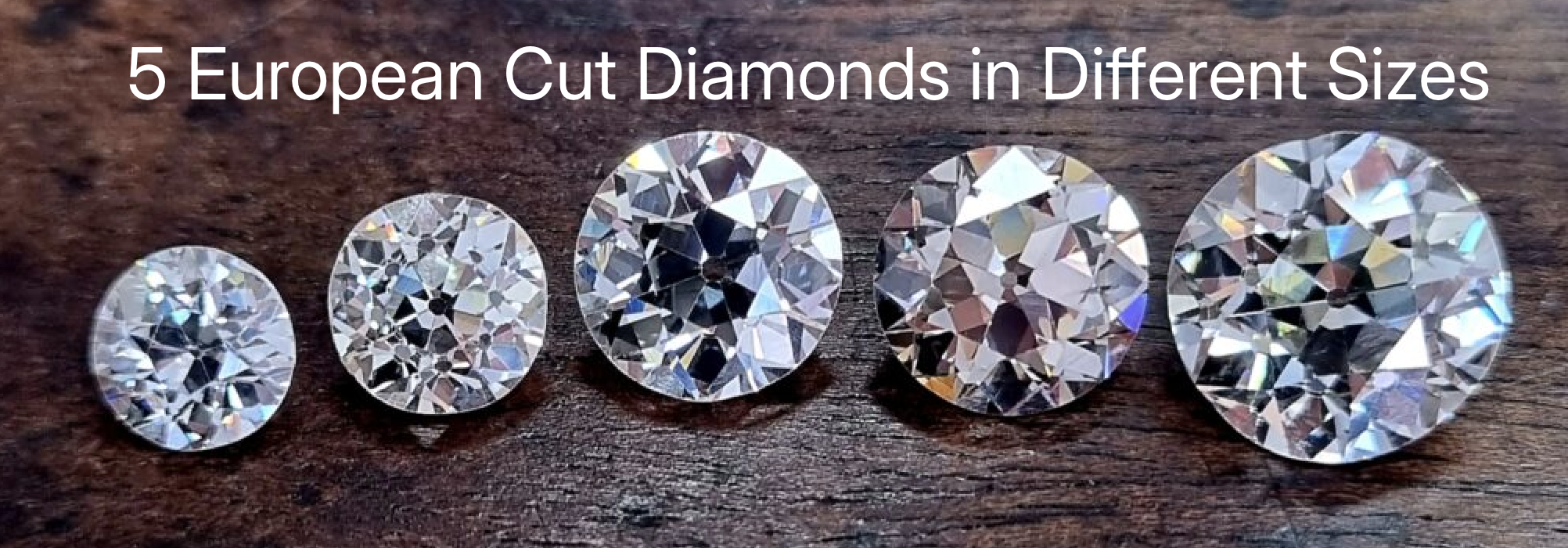
Many of these diamonds were cut in Antwerp, Amsterdam and Paris, where Europe’s best cutters worked. They followed traditions passed down through generations, combining geometry with intuition. Their goal wasn’t to maximize brightness on paper but to give the stone a harmonious look that pleased the eye. You can often recognize a true European Cut by its slightly taller profile and the visible culet at the center when viewed face down. In the picture below you can see the visible culet in some of those European Cut diamonds:
For anyone discovering antique jewelry, identifying a European Cut diamond is like opening a window to history. It captures the craftsmanship of an era when patience and artistry defined perfection. These diamonds may not meet modern standards of symmetry, but they possess a depth and warmth that precision cutting sometimes loses.
How It Evolved from the Old Mine Cut
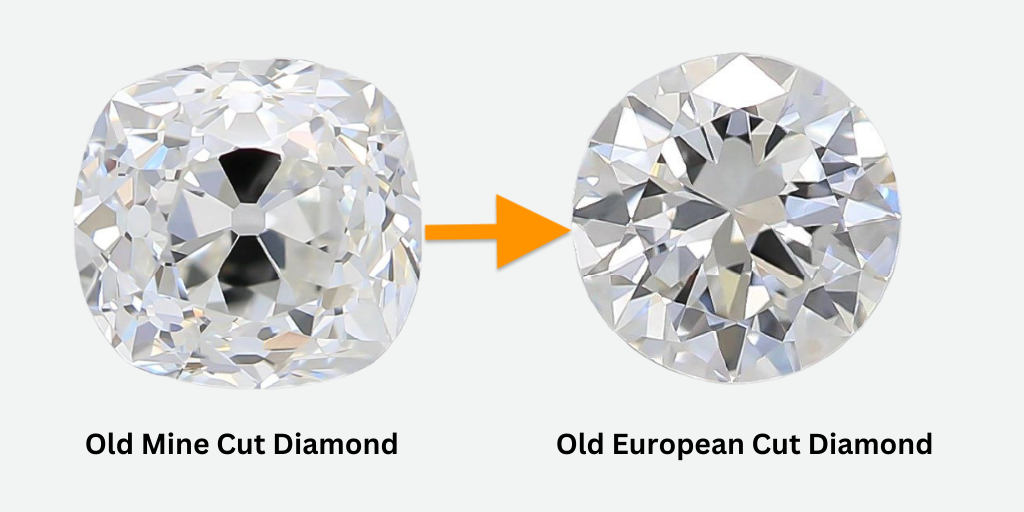
The European Cut didn’t appear out of nowhere. It evolved gradually from the Old Mine Cut, which dominated the 18th and early 19th centuries. The Old Mine Cut was known for its cushion-like shape with rounded corners, a high crown and a deep pavilion. It was made for the light of candles and gas lamps, not for modern electric lighting. Its sparkle was slow and deep, almost like the flicker of firelight, which made it enchanting in its own way.
As diamond cutting tools improved, especially with the invention of the bruting machine in the late 1800s, cutters gained the ability to create more circular outlines. That’s when the Old Mine Cut started to evolve into what became the European Cut. Instead of a squarish cushion, the stone became rounder and its facets were refined for more balanced light reflection. This was one of the biggest transitions in diamond history, from purely hand-guided cutting to a mix of art and emerging technology.
When I first learned about this shift, I was struck by how much it says about human creativity. The Old Mine Cut represents instinct and tradition, while the European Cut marks the start of experimentation and precision. Cutters wanted more brilliance but still valued the warmth and charm of older styles. They began to shorten the pavilion slightly, widen the table and refine facet symmetry so light could bounce more predictably inside the stone.
The change also reflected a new way of seeing beauty. In the past, diamonds were meant to glow under low light, but the spread of electricity in European cities changed how jewelry was viewed. Jewelers wanted diamonds that could perform under brighter lighting, giving rise to new cutting goals. The European Cut was the answer, a bridge between antique softness and modern sparkle.
Workshops in Antwerp, Amsterdam, and Paris played a central role in this transformation. These cities became laboratories of innovation, where cutters experimented with angles and proportions. Some even created personal variations, so two European Cuts from different cities can have slightly distinct personalities. This regional variation is part of what makes them so captivating today.
By the early 1900s, the European Cut was at its peak, embodying both heritage and progress. It set the stage for the invention of the modern round brilliant by Marcel Tolkowsky in 1919. You can still see its DNA in every modern diamond: the same circular shape, similar facet layout but refined through science. When I compare them side by side, I can’t help but see the European Cut as the elegant ancestor of today’s brilliance, a perfect balance between tradition and innovation.
The European Touch: Why It Still Appeals Today
The European Cut continues to charm collectors and vintage jewelry lovers because of how it feels rather than how it measures. Its slower flashes of light have a depth that modern cuts rarely match. When viewed under warm lighting, it seems to breathe rather than sparkle, revealing gentle reflections that shift with every movement. That kind of glow gives the diamond a natural soul and makes it stand out in a world of precision and symmetry.
Many people who fall in love with European Cut diamonds describe them as more human. They’re not perfect and that’s what makes them special. You can see the marks of the cutter’s hand, the slightly uneven facets, and the individuality that comes with each stone. I find that this imperfection creates character and emotion, something that can’t be replicated by computer-guided machines.
Another reason for their appeal is the growing appreciation for sustainability and craftsmanship. A genuine European Cut diamond has already lived a long life, often being passed down through generations. Choosing one is not only a nod to history but also an environmentally conscious decision. It’s a way of celebrating artistry that values time and intention over mass production.
For modern buyers, the European Cut offers a sense of romance and identity. It’s not about chasing maximum brilliance but about connecting with a story. Wearing one feels like carrying a piece of heritage, a small masterpiece from an era when beauty was shaped by light, patience and the human eye.
European Cut vs Modern Brilliant
When comparing a European Cut to a modern brilliant, you’re really seeing two philosophies of beauty. The European Cut was made to please the eye under soft, warm light, while the modern brilliant was engineered for maximum sparkle under bright, direct light. Both share the same basic shape, yet their proportions make them perform very differently.
The most noticeable distinction is in the table and crown. European Cuts have smaller tables and higher crowns, which create a deep, glowing appearance. The modern brilliant has a wider table and lower crown, designed to return light faster. That’s why modern diamonds have that sharp, flashing sparkle, while European Cuts show slower, broader patterns of light that almost seem to pulse from within.
When I look at both side by side, I always notice how the European Cut feels calmer. It doesn’t throw light in every direction but rather releases it in waves, giving a sense of depth. The modern brilliant feels more energetic and lively, sparkling even with the smallest motion. Each has its own personality and which one you prefer often says something about your taste in jewelry, quiet charm or modern fire?
The culet is another defining difference. In European Cuts, the culet is open and often visible, forming a tiny circle when viewed through the table. In modern brilliants, the culet is eliminated, creating a sharp point that reflects more light. Many antique lovers actually find the visible culet beautiful, as it adds a distinctive vintage signature.
Cut precision also changed dramatically between the two eras. European Cuts were made by hand and can have slight variations from one facet to the next, while modern brilliants are cut using machines and lasers to achieve perfect symmetry. I find that precision impressive, but I also think the subtle irregularities in old cuts give them more character. They remind you that a human hand shaped every angle and that perfection wasn’t always the goal.
Ultimately, both cuts represent the ideals of their time. The European Cut is about emotion, warmth, and craftsmanship. The modern brilliant is about precision, technology, and brilliance at all costs. Understanding both makes you appreciate how diamond cutting has evolved – not by replacing beauty, but by redefining it for each generation.
Should You Buy a European Cut Diamond?
If you love jewelry with personality and history, a European Cut diamond is worth considering. It has a warmth that modern stones rarely show and connects you to a time when every facet was guided by touch and intuition. These diamonds tend to cost less than newly cut brilliants of similar size, but their value lies more in character than in perfection. I think they’re perfect for someone who wants a ring that feels timeless rather than trendy.
That said, European Cuts aren’t for everyone. If you prefer sharp sparkle and perfect symmetry, a modern round brilliant will suit you better. But if you appreciate the charm of old-world craftsmanship and the way light moves softly through a hand-cut stone, a European Cut can feel deeply personal. It’s not just a diamond, it’s a story you wear.
…
 Diamond clarity is one of the 4Cs of a diamond that plays an important factor for your diamond purchase. Also, the clarity of the diamond is used in setting up the price on diamond earrings, diamond engagement rings, and diamond pendants. Being said, it is rare for a large-sized diamond to have nothing inside. Hence, the pricier the diamond, the cleaner it is.
 Today, buying an engagement ring has now been a status quo of distinguishing yourself as someone who is already in a relationship and ready to settle down. The cut, pricing and the making of the engagement ring add a special feeling to your engagement day or ceremony.